
Charlotte Mason quotes continue to interest parents, teachers, homeschoolers, and anyone who believes children deserve meaningful learning. Charlotte Mason was a British educator whose philosophy emphasized children as persons, rich ideas, good habits, nature, literature, and a broad education. Her approach is commonly summarized through the ideas that education is an atmosphere, a discipline, and a life.
One important note before you share these lines: the 90 quote-style lines below are original, newly written reflections inspired by major Charlotte Mason ideas. They are not presented as verbatim quotations from Charlotte Mason. This distinction matters because genuine quotations should be traceable to her published works rather than invented and attributed to her.
Mason’s philosophy remains interesting because it treats education as much more than memorizing information. She viewed children as active participants in their own learning and emphasized living ideas, habits, relationships, books, nature, and personal effort.
These original lines are designed for captions, educational posts, homeschooling pages, teacher messages, Pinterest graphics, Facebook posts, Instagram captions, and thoughtful conversations about learning. 📚
📚 Charlotte Mason Inspired Quotes About Education
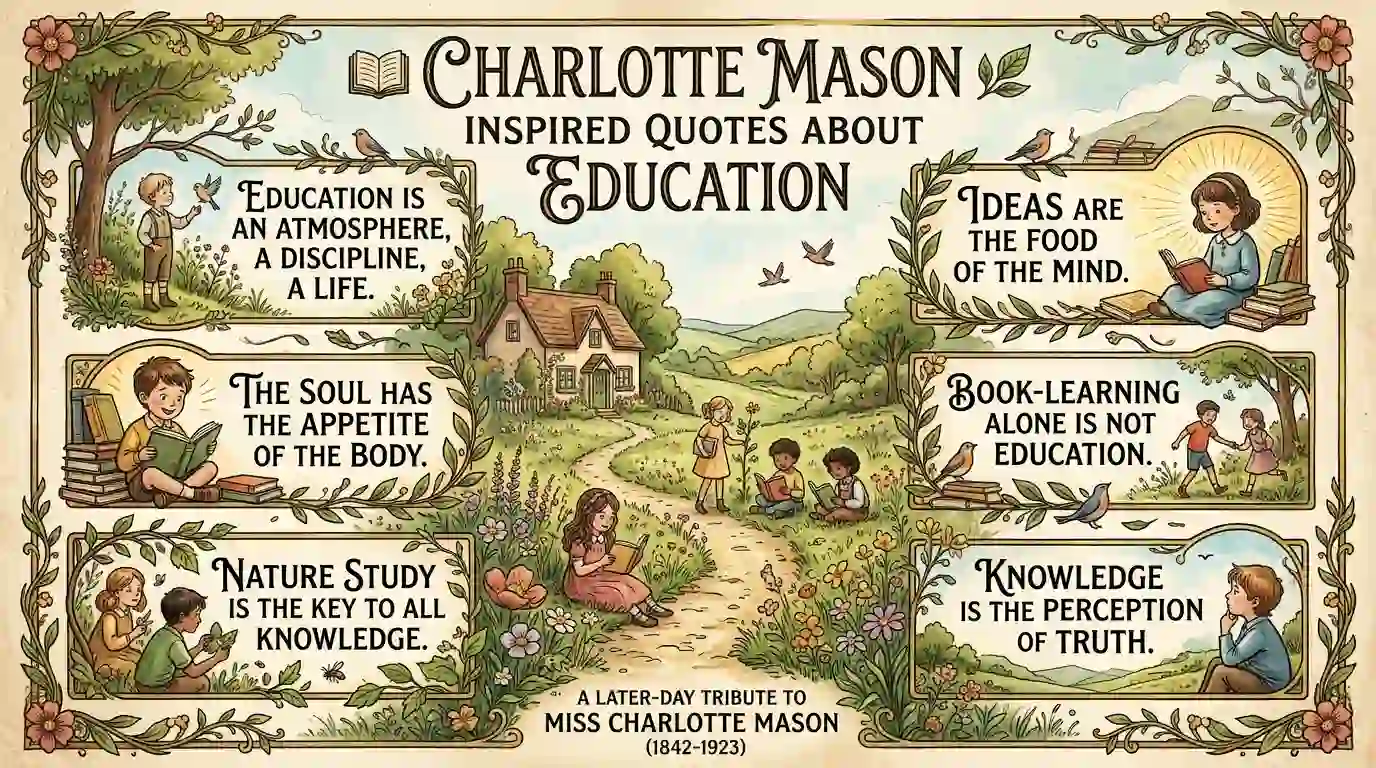
Education is one of the strongest themes associated with Charlotte Mason. Her philosophy challenged the idea that learning should simply mean filling a child’s mind with disconnected facts. Instead, she emphasized generous intellectual nourishment and meaningful ideas. Her educational principles included atmosphere, habit, and living ideas.
Use these original lines when you want a thoughtful caption about teaching, learning, or the purpose of education.
- Education should open the mind, not simply fill a notebook.
- A meaningful lesson gives a child something worth thinking about.
- Good education leaves room for curiosity to breathe.
- Learning becomes richer when children meet ideas instead of endless drills.
- A thoughtful teacher prepares the path, then lets the child walk it.
- Education should nourish the mind with ideas that remain useful beyond school.
- A child deserves lessons that respect both intelligence and imagination.
- The best learning often begins with a question worth asking.
- Education becomes alive when knowledge connects with real life.
- A generous education gives children many doors through which to explore the world.
- Teaching is not only about explaining facts, but about awakening thought.
- A child’s education should stretch the mind without crushing curiosity.
- Great learning gives children reasons to notice, wonder, remember, and think.
- The purpose of education is larger than passing the next test.
- Give children meaningful ideas, and give their minds room to make them their own.
A Charlotte Mason style of education also places importance on the child’s own effort. Her approach includes narration, living books, short focused lessons, and a broad curriculum designed to cultivate attention and a love of knowledge.
That makes these lines useful for educators who want captions that celebrate thoughtful learning rather than grades alone.
🌱 Charlotte Mason Quotes About Children and Childhood
Charlotte Mason’s view of children is central to her philosophy. One of her well-known principles is that children are born persons. She emphasized respecting the child as a person while also recognizing the importance of authority, obedience, habits, and moral development.
The following original reflections are written around that idea.
- A child is a person today, not merely a person in progress.
- Childhood deserves respect, attention, patience, and room to grow.
- Children need opportunities to think, not only instructions to follow.
- A child’s questions can reveal a mind already reaching for knowledge.
- Respecting a child means taking their thoughts seriously.
- Every child brings a different collection of questions to the world.
- Childhood is not a waiting room for adulthood.
- Children can meet great ideas when adults trust their capacity to think.
- A young mind can notice beauty where grown-ups have stopped looking.
- Children need guidance, but they also need space for personal discovery.
- The child who learns to wonder has already begun a lifelong education.
- Treating children with dignity changes the atmosphere of learning.
- A child’s attention is precious, so give it something worth noticing.
- Childhood becomes richer when books, nature, conversation, and experience meet.
- Teach the child before you teach the lesson, because the learner is a person first.
For parents and teachers, this perspective can change everyday interactions. Instead of seeing a child only through grades, behavior, or completed assignments, it encourages adults to consider the child’s developing mind, character, interests, and relationships.
This is one reason Mason’s ideas continue to attract families interested in homeschooling and child-centered educational philosophy. Her writings repeatedly return to the importance of personhood, relationships, ideas, habits, and a rich curriculum.
🌿 Charlotte Mason Inspired Quotes About Nature and Learning
Nature study is another important part of the Charlotte Mason approach. Rather than treating nature only as a collection of scientific facts, her educational philosophy encouraged children to spend time outdoors, observe living things carefully, and develop a direct relationship with the natural world.
These original quotes work well for nature study captions, homeschool posts, outdoor learning photos, and family memories.
- Nature turns an ordinary walk into an invitation to notice.
- A child who watches closely can find a lesson beneath every leaf.
- Outdoor learning begins when curiosity steps beyond the classroom.
- The natural world teaches patience because nothing unfolds on command.
- A bird, a cloud, or a flower can become the beginning of a wonderful question.
- Nature study asks children to look before they rush to explain.
- The outdoors gives young minds room to wonder without a worksheet.
- Learning becomes personal when a child discovers something firsthand.
- A quiet walk can teach attention better than a noisy room.
- Nature offers lessons that cannot always be reduced to a paragraph.
- The more carefully we observe the world, the more interesting it becomes.
- A child’s notebook becomes special when it holds something they truly noticed.
- Learning from nature means meeting the real world with open eyes.
- Every season brings fresh material for a curious mind.
- Let children explore the living world, and watch observation become knowledge.
Nature study can also make learning feel less separated from everyday life. A walk through a park, garden, woodland, or neighborhood can lead to questions about birds, plants, weather, insects, seasons, geography, art, and writing.
Mason’s approach encouraged adults to make regular outdoor observation possible while allowing children to look, think, ask questions, and discover.
For a social media caption, a simple nature photograph paired with one of these original lines can communicate the beauty of learning through direct experience. 🌳
📖 Charlotte Mason Inspired Quotes About Books and Living Ideas
Books occupy an important place in Charlotte Mason’s educational philosophy. Her approach favored “living books”, meaning books that communicate ideas through engaging, meaningful writing rather than reducing every subject to dry information.
These original lines are useful for reading posts, homeschool book photos, teacher captions, library visits, and family reading moments.
- A good book does more than provide information; it gives the mind something to carry.
- Reading becomes powerful when a child meets an idea worth remembering.
- Give a curious mind a worthy book and see where the conversation goes.
- A living book can turn a subject into a story worth following.
- The right book makes learning feel like discovery rather than duty.
- Children deserve books that speak to their minds without talking down to them.
- A bookshelf can become a map of places a child has never visited.
- Stories give facts a place to live inside the imagination.
- Reading widely gives the mind more connections to make.
- A meaningful book can become a quiet teacher long after the page is closed.
- Great writing invites children to think with the author and then think for themselves.
- Books can introduce children to people, places, ideas, and questions beyond their daily lives.
- A child’s reading life grows when curiosity chooses the next page.
- Knowledge becomes memorable when it arrives wrapped in a compelling story.
- Fill childhood with worthy books, and you may also fill it with lifelong questions.
The goal is not simply to collect books. The deeper idea is to offer children a broad intellectual diet containing literature, history, science, poetry, art, and other subjects that invite thought. Mason described the mind as needing intellectual nourishment and argued for a generous curriculum.
For social media, these lines can pair naturally with a photograph of a reading corner, a stack of books, a library visit, or a child enjoying independent reading.
🧠 Charlotte Mason Inspired Quotes About Habits, Character, and Discipline
Habit formation is another major part of Mason’s educational thought. She viewed education as a discipline partly because habits shape everyday behavior and character. Her philosophy emphasized thoughtful habit formation rather than depending entirely on repeated correction.
These original lines can work well for parenting posts, teacher captions, homeschool reflections, and reminders about consistency.
- Character grows through the small choices repeated each day.
- A good habit begins as an effort and becomes easier through practice.
- Consistency quietly teaches what occasional speeches cannot.
- Discipline works best when it trains the heart as well as the action.
- A small daily habit can become a lifelong strength.
- Patience is easier to teach when children see it practiced.
- Attention grows when we deliberately make room for attention.
- Good habits give children tools they can carry into adulthood.
- Character is shaped in ordinary moments, not only extraordinary ones.
- The habits we practice today can influence the people we become tomorrow.
- Gentle consistency can accomplish more than constant reminders.
- Teaching a habit is teaching a child how to act with increasing independence.
- Self-control grows through practice, patience, and purposeful guidance.
- A peaceful routine can make room for both responsibility and joy.
- Strong character is built quietly, one faithful choice at a time.
Habit training does not have to mean creating a rigid household where every moment is controlled. In Mason’s philosophy, the goal is thoughtful formation of useful habits while respecting the child’s personhood. Her broader principles connect authority and obedience with respect for children.
For parents, this can be a useful reminder that character education happens throughout the day. Morning routines, attention during lessons, honesty, courtesy, responsibility, and persistence can all become opportunities for growth.
💡 Charlotte Mason Inspired Quotes for Parents, Teachers, and Homeschoolers
Charlotte Mason’s ideas can be especially meaningful for parents and teachers because her philosophy places responsibility on the adults to create a rich educational atmosphere while giving children opportunities to participate actively in learning. Her approach also encourages a broad curriculum and direct contact with books, nature, art, history, science, and other sources of knowledge.
Here are original lines for teachers, parents, homeschoolers, and anyone who wants to encourage lifelong learning.
- A teacher does not have to know everything to help a child love learning.
- Parents teach through lessons, but they also teach through the atmosphere they create.
- The home can become a place where curiosity is welcomed every day.
- A homeschool is more than a schedule; it is a culture of learning.
- Teachers guide attention, but children must do the thinking.
- A parent can provide the book, the question, and the opportunity, then let curiosity work.
- Good teaching leaves children with something to explore after the lesson ends.
- Homeschooling can make ordinary moments part of a larger education.
- The atmosphere adults create can speak before a lesson begins.
- A teacher’s love of learning can become an invitation for students to love it too.
- Parents do not need perfect days to create meaningful learning.
- The best educational routines leave space for questions and unexpected discoveries.
- Teaching is partly the art of knowing when to explain and when to step back.
- Children learn from the books we choose, the habits we model, and the questions we welcome.
- A rich education asks adults to prepare carefully and children to participate wholeheartedly.
These lines can work especially well for teacher appreciation posts, homeschool Instagram captions, Facebook groups, classroom displays, educational newsletters, and personal reflections.
Mason’s philosophy does not reduce education to a single technique. Instead, it connects environment, habits, ideas, books, nature, relationships, and the child’s own work.
❓ Frequently Asked Questions About Charlotte Mason Quotes
What is Charlotte Mason best known for?
Charlotte Mason is best known for an educational philosophy that emphasizes children as persons, living ideas, habits, nature study, literature, narration, and a broad curriculum. Her work is commonly summarized through the phrase that education is an atmosphere, a discipline, and a life.
What are the main ideas behind Charlotte Mason’s philosophy?
Her philosophy includes respect for children as persons, thoughtful habit formation, a rich atmosphere, living ideas, living books, nature study, narration, and a generous curriculum.
Are the quotes in this article actual Charlotte Mason quotations?
The 90 quote-style lines in this article are original reflections inspired by Charlotte Mason’s educational ideas. They are not presented as direct quotations from her published works.
Why are Charlotte Mason quotes popular with homeschoolers?
Her ideas appeal to many homeschoolers because they emphasize rich books, nature, curiosity, habits, short focused lessons, narration, and learning through meaningful ideas.
What does “education is an atmosphere” mean?
It refers to the educational influence of a child’s surroundings, relationships, home life, and the ideas that shape everyday living. Mason did not mean simply creating an artificial environment designed specifically for children.
What are living books in Charlotte Mason education?
Living books are generally understood as engaging books that communicate meaningful ideas through strong writing rather than presenting information as disconnected facts. They are an important part of the Charlotte Mason approach.
Why is nature study important in the Charlotte Mason approach?
Nature study gives children direct experience with the natural world and encourages observation, attention, curiosity, and deeper relationships with living things.
Can these Charlotte Mason inspired quotes be used on social media?
Yes. The original lines in this article can be adapted for Facebook posts, Instagram captions, Pinterest graphics, WhatsApp statuses, teacher pages, homeschool communities, and educational messages.
🌟 Final Thoughts
Charlotte Mason’s educational ideas continue to give parents and teachers plenty to think about. Her emphasis on children as persons, meaningful ideas, good habits, rich books, nature, and lifelong learning offers a thoughtful way to look at education.
Pick the line that best matches your moment, turn it into a caption, add it to a classroom post, or share it with a fellow parent or teacher. 📚🌿 Sometimes one simple idea is enough to make us look at learning a little differently.