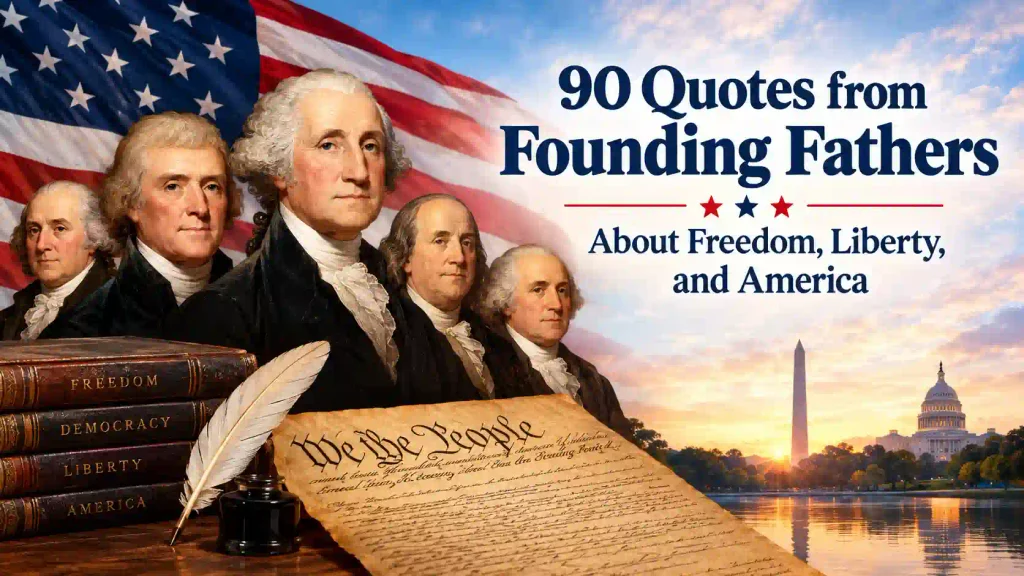
Quotes from founding fathers offer powerful ways to reflect on American freedom, liberty, democracy, leadership, and the responsibilities of citizenship. From George Washington and Thomas Jefferson to Benjamin Franklin, John Adams, and James Madison, the founding generation left behind words and ideas that continue to inspire history lovers, students, teachers, and Americans today.
Whether you need a meaningful American history caption, a patriotic Facebook post, an Independence Day message, or a quote for a classroom discussion, the words of America’s founders can give your message greater depth. Some remind us to protect freedom, others encourage education and public service, and many invite us to think carefully about what makes a nation strong.
One important detail matters when sharing historical quotations: the exact wording and attribution should be verified. The original quotes in the collections below are newly written reflections inspired by the founders’ documented principles, not historical quotations attributed to them. Where you need an authentic quotation from a particular founder, consult a reliable historical source before publishing it.
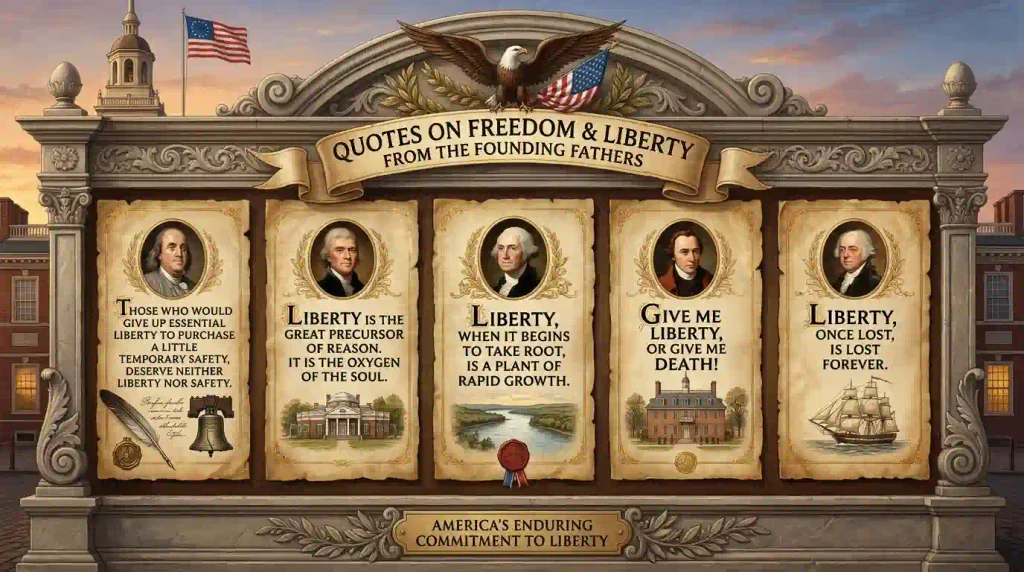
🇺🇸 Quotes from Founding Fathers About Freedom and Liberty
Freedom was central to the American founding, but liberty also comes with responsibility. These original reflections explore personal freedom, equal rights, and the importance of protecting the principles that help a society flourish.
- “Freedom means little unless every person has a fair chance to enjoy it.”
- “Liberty grows stronger when people understand the rights of others.”
- “A free nation needs citizens who care about more than themselves.”
- “The value of independence lies in the choices it allows us to make.”
- “Rights are worth celebrating, and responsibilities are worth remembering.”
- “True liberty gives people room to think, question, and create.”
- “A nation protects freedom by refusing to take it for granted.”
- “The spirit of independence begins with the courage to think freely.”
- “Freedom becomes meaningful when fairness reaches beyond our own circle.”
- “A just society respects the dignity of every individual.”
- “Liberty is not a gift to admire from afar, but a principle to practice.”
- “The strongest freedoms are supported by informed and thoughtful citizens.”
- “Independence gives a people the opportunity to shape their own future.”
- “A country honors liberty when its laws protect people fairly.”
- “Freedom thrives when courage is guided by wisdom.”
Share these reflections in an American history presentation, a Fourth of July post, or a discussion about civil rights. They work particularly well when your caption needs to express patriotism without losing sight of the responsibilities that come with citizenship.
📜 2. Quotes from Founding Fathers About Democracy and Government
The founders debated how a new nation should govern itself. Their political legacy includes the Constitution, the separation of powers, and continuing discussions about representation and accountability. The following original lines explore those ideas in modern language.
- “Good government begins by remembering whom it serves.”
- “A public office is a responsibility, not a personal trophy.”
- “Democracy works best when citizens participate beyond election day.”
- “A nation’s leaders should answer to the people they represent.”
- “The strength of a republic depends on the wisdom of its citizens.”
- “Rules matter most when they apply fairly to everyone.”
- “A healthy government welcomes accountability instead of avoiding it.”
- “Representation means listening, not simply speaking for others.”
- “Public trust is earned through actions, not promises.”
- “A constitution gives a nation a framework, but people must uphold its principles.”
- “Disagreement can improve a democracy when respect remains in the room.”
- “The best political decisions consider the people who have the least influence.”
- “A government becomes stronger when power has clear limits.”
- “Citizenship includes asking difficult questions of those in authority.”
- “Democracy is a shared responsibility, renewed through every generation.”
These lines suit civics assignments, classroom displays, debate introductions, and social media posts about democratic values. If you are discussing a particular founder’s political philosophy, add historical context rather than suggesting every founder held the same views.
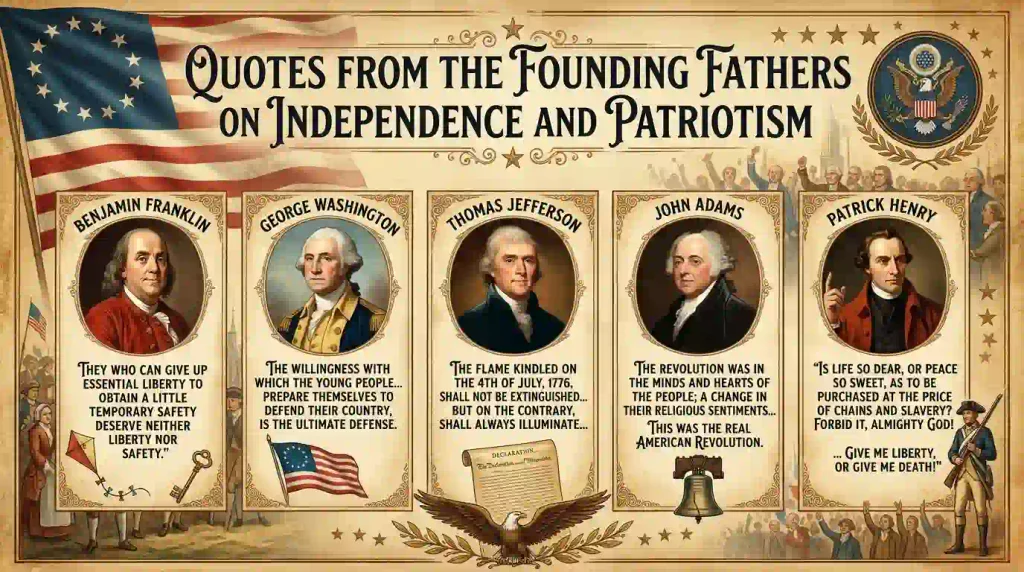
🕊️ 3. Quotes from Founding Fathers About Independence and Patriotism
American independence represents a defining moment in the nation’s history. Patriotism can celebrate that achievement while also encouraging people to contribute to their communities and consider how the country can continue to improve.
- “Patriotism means caring enough to help your country grow.”
- “Independence gave America a future it could begin shaping for itself.”
- “Love of country is strongest when matched by service to others.”
- “A nation’s story is written by the choices of its people.”
- “Celebrate the freedom, remember the struggle, and respect the responsibility.”
- “The American spirit shines brightest when courage meets purpose.”
- “A flag can symbolize a promise that citizens must work to fulfill.”
- “National pride becomes meaningful when it inspires positive action.”
- “Independence is a milestone, not the end of a nation’s journey.”
- “Honor the past by helping build a better future.”
- “A country grows when its people turn shared ideals into daily actions.”
- “Patriotism can mean celebrating progress while working to correct mistakes.”
- “The story of America belongs to every generation that helps shape it.”
- “A meaningful tribute to history includes learning from its difficult chapters.”
- “The best way to honor a founding vision is to keep improving upon it.”
For Independence Day captions, pair one of these lines with a photo of a community celebration, a historical landmark, or an American flag. They are also suitable for school newsletters and patriotic messages that focus on civic participation.
📚 4. Quotes from Founding Fathers About Education and Wisdom
Education played an important role in the political and intellectual culture of the founding era. Learning about history, examining evidence, and considering different viewpoints can help modern readers understand both the achievements and the contradictions of America’s early leaders.
- “An educated citizen can question yesterday and improve tomorrow.”
- “Knowledge gives curiosity a direction and judgment a foundation.”
- “Read history to understand the past, not to escape the present.”
- “Wisdom begins when we admit that we still have more to learn.”
- “A thoughtful question can open a door that certainty keeps closed.”
- “Learning is a lifelong conversation between evidence and ideas.”
- “Good judgment grows when knowledge meets humility.”
- “History becomes useful when we examine its lessons honestly.”
- “An open mind is willing to reconsider an old conclusion.”
- “Education prepares people to participate, not merely to observe.”
- “The habit of asking why can be more valuable than memorizing what.”
- “A well-informed community makes better decisions together.”
- “Great ideas deserve examination, not unquestioning admiration.”
- “The past offers guidance when we study its successes and failures.”
- “Curiosity keeps the mind independent.”
Use these reflections in school essays, history club posts, graduation messages, or classroom presentations. For academic work, support them with primary sources and specific historical examples instead of presenting them as authentic words spoken by a founding figure.
🤝 5. Quotes from Founding Fathers About Leadership and Responsibility
Leadership was a major concern for America’s early political thinkers. George Washington’s presidency, John Adams’s public service, and James Madison’s work on constitutional government offer different starting points for examining leadership. These original reflections focus on integrity, cooperation, and service.
- “A leader earns respect by accepting responsibility when decisions go wrong.”
- “Public service should begin with a question: how can I help?”
- “Integrity matters most when nobody is checking your work.”
- “A wise leader listens before deciding which direction to take.”
- “Leadership is measured by the trust people place in your actions.”
- “The willingness to learn is a strength, not a weakness.”
- “Responsible leaders consider consequences beyond their own time in office.”
- “Cooperation turns individual effort into a shared achievement.”
- “A promise has value when consistent action follows it.”
- “The courage to admit a mistake can restore confidence.”
- “Good leadership makes room for capable people to contribute.”
- “A thoughtful decision considers evidence before applause.”
- “Service is most meaningful when personal ambition takes a back seat.”
- “Respectful disagreement can help leaders discover a better answer.”
- “A lasting legacy comes from principles practiced, not speeches delivered.”
These lines can add meaning to a leadership essay, a graduation speech, a team appreciation post, or a message recognizing someone who serves their community. They also make useful discussion starters for students studying Washington, Adams, Madison, and other figures from the founding era.
⭐ 6. Quotes from Founding Fathers for Captions and Social Media
Sometimes a short line is all you need. These original, history-inspired captions are designed for Instagram, Facebook, TikTok, WhatsApp status updates, and conversations with friends. They connect American founding ideals with everyday language while remaining separate from authentic historical quotations.
- “Liberty looks good on a nation that respects everyone.”
- “History class, but make it about the future.”
- “Independent thinking is always worth celebrating.”
- “Red, white, blue, and a little historical curiosity.”
- “Democracy needs more thoughtful voices and fewer careless assumptions.”
- “A little history can put today’s headlines into perspective.”
- “Founding principles, modern questions, endless conversations.”
- “Learning from history is a patriotic habit.”
- “America’s story is still being written.”
- “Bring curiosity to the classroom and courage to the conversation.”
- “Civics is more interesting when everyone joins in.”
- “A great nation keeps asking how it can do better.”
- “Old documents, big ideas, and questions that still matter.”
- “History reminds us that change begins with people.”
- “Celebrate the ideals, study the evidence, and keep thinking.”
How to choose the right caption 🇺🇸?
A good caption should fit both your message and your audience.
- For Independence Day: Choose a line about freedom, independence, or shared responsibility.
- For school assignments: Select a reflection about education, government, or historical understanding.
- For civic discussions: Use a line about accountability, representation, or respectful disagreement.
- For social media: Pick a short caption that makes sense without a lengthy explanation.
- For a historical tribute: Pair an original reflection with a separately verified quotation from the founder you are discussing.
Remember that the lines in these six collections are original reflections, not verified quotations from George Washington, Thomas Jefferson, Benjamin Franklin, or other historical figures. If you need actual quotations, the National Archives’ Founders Online collection provides access to historical documents and correspondence.
Frequently Asked Questions
What are the most famous quotes from the Founding Fathers?
Frequently cited historical quotations include Patrick Henry’s call for liberty, Benjamin Franklin’s reported description of the new government as a republic, and statements from Thomas Jefferson about equality and independence. Verify exact wording and context through reliable historical collections before using any quotation.
Who were the main Founding Fathers of the United States?
Commonly recognized figures include George Washington, Thomas Jefferson, Benjamin Franklin, John Adams, James Madison, Alexander Hamilton, and John Jay. Many other people also contributed to American independence and the development of the early republic.
What did the Founding Fathers believe about freedom?
Their views differed, but liberty and self-government were central themes in the founding documents. Their understanding of freedom was also shaped by major contradictions, including slavery and the exclusion of women and other groups from equal political rights.
What are good Founding Fathers quotes for Independence Day?
Choose a verified quotation about independence, liberty, or civic responsibility. For a short social media post, you can also use one of the original patriotic reflections above, provided it is not attributed to a historical figure.
Can I use Founding Fathers quotes in a school assignment?
Yes. Historical quotations can support essays, presentations, and classroom discussions when they are accurately transcribed, properly attributed, and explained in context. Include a source citation when required by your teacher.
Where can I find authentic quotes from the Founding Fathers?
Start with the National Archives’ Founders Online collection, which contains searchable historical documents and correspondence from prominent founders. George Washington’s Mount Vernon website also explains how to identify misattributed or inaccurate quotations.
Are all quotes commonly attributed to the Founding Fathers authentic?
No. Some popular sayings have been altered, taken out of context, or incorrectly attributed. Check the original document or a trustworthy historical institution before presenting a quotation as fact.
A final thought:
The founding era offers plenty to explore, from the promise of liberty to the challenges of building a representative government. These original reflections can help you share those ideas in a classroom, a patriotic post, or a thoughtful conversation.
Choose the line that speaks to you, pair it with a meaningful image, and share it with friends. And when you use a famous founder’s actual words, take a moment to verify the quotation. History deserves both appreciation and accuracy.